
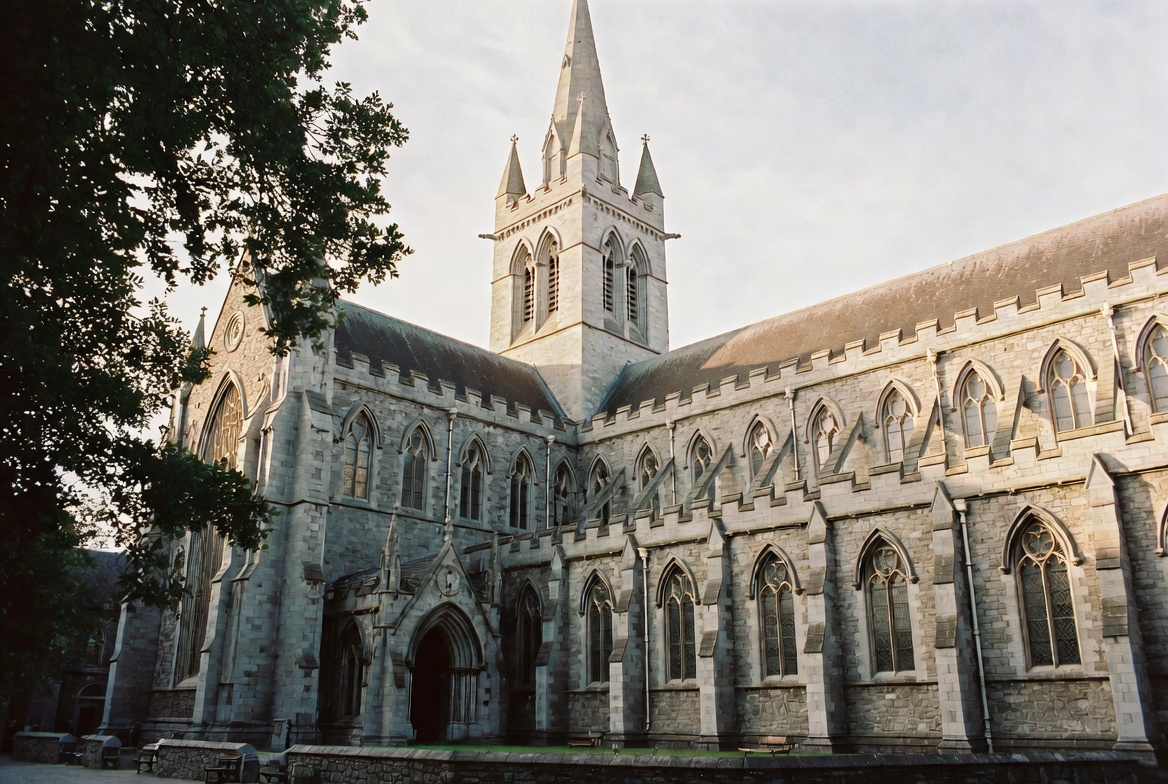
Founded outside the medieval city walls in 1191 — perhaps to escape the jurisdiction of Christ Church, perhaps as a deliberate parallel — Saint Patrick's grew through the thirteenth century into the longest church in Ireland and remains the National Cathedral of the Church of Ireland. It stands on what is traditionally identified as the site at which Saint Patrick himself baptised Christian converts from a holy well.
Anglo-Norman Foundation
The cathedral's founder, Archbishop John Comyn, raised it from collegiate church to cathedral status in 1191. The result is a unique Irish anomaly: two cathedrals, two chapters, and centuries of jurisdictional argument between Saint Patrick's and Christ Church on which was the senior. The matter was settled in 1300 by the Pacis Compositio: Christ Church the senior in dignity, Saint Patrick's the senior in size. The truce has held.
Swift's Cathedral
Jonathan Swift was Dean of Saint Patrick's from 1713 until his death in 1745. His tomb is in the south aisle, beside that of Esther Johnson — the Stella of his journals — and his self-composed Latin epitaph remains the most ferocious in any cathedral in the British Isles: "where savage indignation can no longer tear his heart." Swift's bust, his pulpit, and the bookcases of his private library survive within the cathedral, and his shadow falls across every tour.
"Where savage indignation can no longer tear his heart. Go, traveller, and imitate, if you can, this earnest and dedicated champion of liberty."— Swift's epitaph, his own translation
Restoration and Living Cathedral
By the early nineteenth century the cathedral was in poor structural condition. A complete restoration funded by Sir Benjamin Lee Guinness between 1860 and 1865 — at the staggering cost of £150,000 — saved the building, though at the cost of much medieval detail. The result is the cathedral we visit today: a long, light, austere Gothic interior of grey limestone, hung with the regimental colours of the Irish regiments and the heraldry of the Knights of Saint Patrick.
What You'll See on the Tour
- The nave, the choir, and the Lady Chapel
- Swift's tomb, his bust, and the Door of Reconciliation
- The banners of the Knights of Saint Patrick
- The Boyle Monument — "the most extravagant monument in any Irish church"
- The grave-slab of Saint Patrick's well
Visiting Notes
Saint Patrick's is universally accessible at ground floor; choral services are sung daily during term and are open to visitors. The choir of Saint Patrick's is the school choir of the cathedral choir school, the oldest in Ireland.