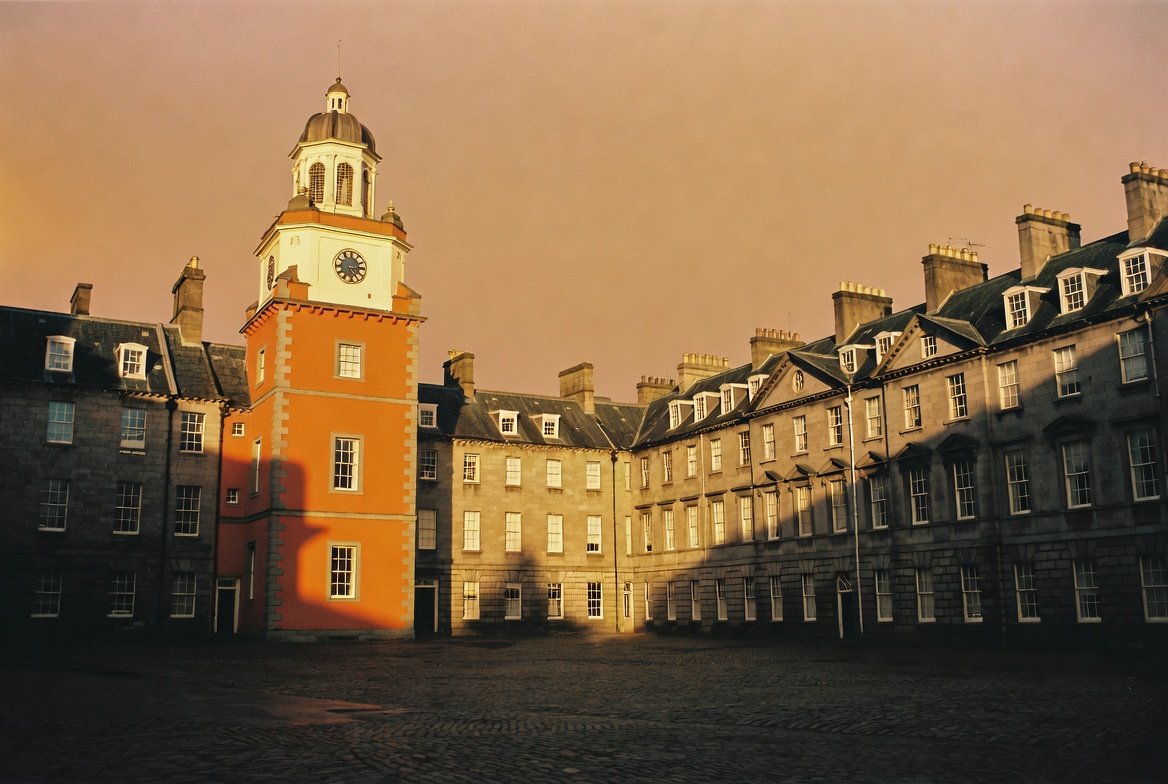
From its founding by King John in 1204 until the handover to the Free State in January 1922, Dublin Castle served as the seat of English — and later British — government in Ireland. No other building in the country carries so directly the weight of the long Anglo-Irish settlement, and few have been so persistently rebuilt and reused.
Norman Foundations
The Castle was built on the highest defensible ground inside the medieval walls of Dublin, at the confluence of the Liffey and the long-buried Poddle. Its plan was a classic Anglo-Norman quadrilateral: four corner towers linked by curtain walls, with the dark tidal pool — the Dubh Linn from which the city takes its name — serving as the southern moat.
Of the original medieval fabric, two towers and substantial sections of curtain wall survive. The Record Tower, completed around 1228, is the only intact medieval tower remaining and is the oldest standing structure in the city. The Powder Tower, partially excavated and now visible beneath the modern building, contains the most complete remains of the early Anglo-Norman defences in Ireland.
"The castle of Dublin, with its fosses well watered and stoutly walled with cement and stone, will be a fitting house for the king's court and treasure."— King John's writ to the Justiciar, 1204
Georgian Reconstruction
A catastrophic fire in 1684 destroyed much of the medieval residential range. Successive Lords Lieutenant rebuilt the castle in the eighteenth century as a palace fit for a viceregal court — most visibly in the State Apartments along the south side of the Upper Yard, designed for the formal entertainments and audiences that gave Dublin its short-lived eighteenth-century glamour.
The St Patrick's Hall ceiling, painted by Vincenzo Valdrè in the 1780s, depicts the conversion of King Lóegaire by Saint Patrick, the surrender of Hugh O'Neill at Mellifont, and George III supported by Liberty and Justice. It is the most ambitious painted interior in Ireland.
Handover and Republic
On 16 January 1922, in a brief and famously informal ceremony, Lord FitzAlan handed Dublin Castle over to Michael Collins as Chairman of the Provisional Government. The traditional anecdote — that the British complained Collins was seven minutes late, and Collins replied "we've been waiting seven hundred years, you can have your seven minutes" — is almost certainly apocryphal but has stuck because the truth it gestures at is real.
Today the Castle hosts inaugurations of the President of Ireland, state banquets, EU Presidency events and the Easter Monday commemorations. Conservation work is continuous, and active archaeological excavation in the Lower Yard regularly produces new finds from the Hiberno-Norse and Anglo-Norman periods.
What You'll See on the Tour
- The State Apartments, including St Patrick's Hall and the Throne Room
- The Chapel Royal (1814) by Francis Johnston
- The Medieval Undercroft, with the surviving sections of the original Anglo-Norman wall and the Powder Tower
- The Dubh Linn Gardens on the site of the original tidal pool
Visiting Notes
The State Apartments and Chapel Royal are universally accessible. The Medieval Undercroft is reached only by stairs. Tours run continuously through the day; the small-group historian-led tour is the recommended option for visitors with a serious interest in the building.