
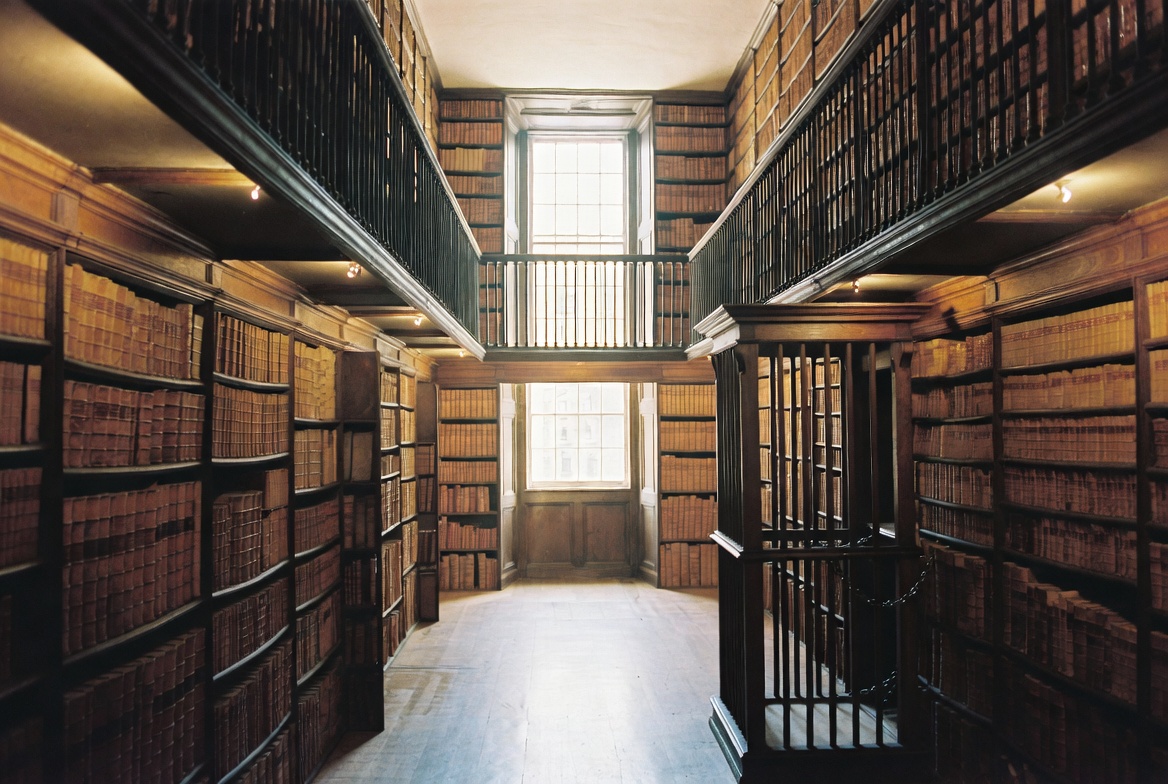
Tucked behind Saint Patrick's Cathedral, Marsh's Library is a Queen Anne interior that has scarcely altered in three centuries. The same dark oak bookcases, the same locked reading cages, the same 25,000 volumes purchased by Archbishop Narcissus Marsh between 1690 and 1713: it is the only library in these islands that has retained its founding furniture, books and architecture together.
An Archbishop's Library
Narcissus Marsh, Provost of Trinity College and successively Archbishop of Cashel, Dublin and Armagh, was Ireland's most learned senior clergyman. Frustrated by Trinity's restrictive lending rules, he conceived a public library in which "all gentlemen and graduates" could read freely. He commissioned Sir William Robinson — the architect of the Royal Hospital Kilmainham — to design the building, and laid the foundation stone in 1701. The library opened to readers in 1707.
The Cages
The library's most striking feature is its three eighteenth-century reading cages. Readers wishing to consult particularly valuable books were locked into wooden cages, partly to deter theft and partly because the books were chained to the desks within. The keys still hang on the wall. The cages are entirely original.
"He had read all the books that he could lay his hands upon — Latin, Greek and English."— James Joyce, on Stephen Dedalus reading at Marsh's, A Portrait of the Artist as a Young Man
Famous Readers
Jonathan Swift, Dean of Saint Patrick's next door, was one of the library's earliest and most assiduous users; some of his marginalia survives in books still on the shelves. Bram Stoker, a graduate of Trinity, used the library while researching the folklore that became Dracula. James Joyce sent Stephen Dedalus there in A Portrait of the Artist as a Young Man, and used Joachim of Fiore — found at Marsh's — in Ulysses. Recent readers have included Seamus Heaney and Hilary Mantel.
The Collection
The four collections together hold around 25,000 books, most printed between the 16th and 18th centuries: theology, classical literature, medicine, science, mathematics, French literature and Hebrew studies. The library is still in active use as a reading library; it is also a fully accessible museum.
What You'll See on the Tour
- The original Queen Anne interior, unaltered since 1707
- The three reading cages
- Swift's books and marginalia (a small case is rotated weekly)
- Manuscripts from the 1600s
- The exhibition gallery and the conservation studio
Visiting Notes
Marsh's is reached by a short flight of steps from Saint Patrick's Close; an accessible entrance is available with advance notice. The library is small: tours are deliberately limited to ten visitors at a time.