
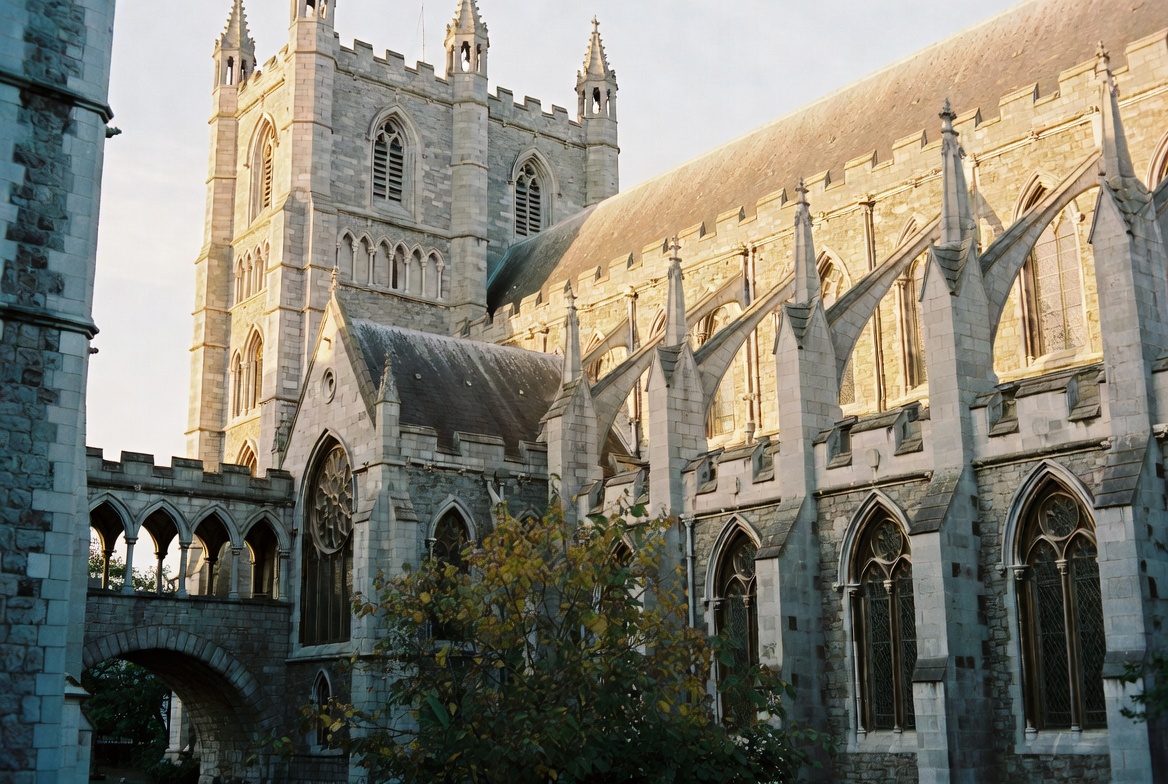
Christ Church Cathedral — properly the Cathedral of the Holy Trinity — is the older of Dublin's two medieval cathedrals and the spiritual seat of the Anglican Archbishop of Dublin. It stands on the high ground south of the Liffey where the Viking longphort first became a town, and it has been continuously in use as a place of Christian worship for nearly a thousand years.
The Viking Cathedral
Christ Church was founded around 1030 by Sitric Silkenbeard, the Hiberno-Norse King of Dublin, on his return from a pilgrimage to Rome. The first cathedral was a wooden building; nothing visible of it survives. The first stone church was begun in 1172 by the Anglo-Norman warlord known to the Irish as Strongbow, who is buried in the south aisle. His tomb was a major site of mercantile pilgrimage in the late Middle Ages: Dublin merchants would conclude their bargains "before the tomb of Strongbow."
The Crypt
Beneath the modern cathedral lies the largest medieval crypt of any cathedral in Britain or Ireland — a virtually intact Romanesque undercroft, sixty metres long, completed in the 1170s. It was used as a marketplace and even a tavern through the seventeenth century. Today it houses the cathedral's treasury, the famous mummified cat-and-rat (trapped in the organ pipes some time around 1850), and the stocks once used to punish citizens of the Liberty of Christ Church.
"To go down into the crypt is to descend out of every later century at once. The light shifts, the air changes; you are inside the building's own memory."— from a current tour notebook
Reconstruction and Restoration
The medieval cathedral was structurally compromised by the collapse of the south wall in 1562. The Victorian restoration by George Edmund Street between 1871 and 1878 — funded by the distiller Henry Roe — was so thorough that the surviving original fabric is now confined largely to the transepts and the crypt. The result is nonetheless a coherent and atmospheric building, its proportions Norman, its detailing mostly Victorian, its location unmistakably medieval Dublin.
What You'll See on the Tour
- The nave, transepts, and the surviving Romanesque doorway in the south transept
- The crypt — the most extensive medieval undercroft in Britain or Ireland
- The Strongbow Monument and the Treasury
- The medieval tile floor of the Lady Chapel
- The covered bridge to the Synod Hall (now Dublinia)
Visiting Notes
The cathedral floor is partially uneven; the crypt is reached by twenty-two stairs (a lift is available with advance notice). Choral evensong is sung Tuesdays through Thursdays during term and is open to all visitors.